

Field report · Updated October 2026
Health disparities in rural Guatemala and the impact of Dr. Pelico’s clinic
Rural Guatemala faces some of the most severe health disparities in Central America, driven by geographic isolation, linguistic exclusion, chronic underfunding, and the near‑total absence of Indigenous‑speaking clinicians. This report brings together available public health data with on‑the‑ground findings from Aldea Pitzal, where Dr. Pelico is delivering a model of community‑rooted, linguistically inclusive care.
1. Why care is so hard to reach
Distance. About 80% of Guatemala’s physicians work in Guatemala City, leaving rural areas chronically underserved. In Alta Verapaz, where many Indigenous communities live, 23% of the population is more than an hour from any basic health facility. Rural Indigenous families often travel 3–6 hours to reach a diagnostic facility, and transport can cost Q100–Q150, often more than a family’s weekly income.
Cost. Private clinics charge about Q300 ($40) per visit, while rural families often earn Q15–Q25 a day. A single visit can cost the equivalent of several days of income.
Language. Guatemala has 25 Indigenous languages and 40% of the population identifies as Indigenous, yet most healthcare providers speak only Spanish. For K’iche’‑speaking patients, miscommunication leads to misdiagnosis, mistrust and avoidance of care.
Underfunding. Guatemala’s total health spending is about $392 per person per year (WHO, 2023), a fraction of what wealthier countries spend. The system is divided into public, private and social security sectors, and the public sector carries most rural care while being the most under‑resourced. Rural clinics often lack medications, imaging, labs, electronic records and trained personnel, and maternal and child health indicators remain among the most challenging in Central America.
Together, distance, cost, language and underfunding create preventable suffering.

2. Field findings in Aldea Pitzal
Aldea Pitzal represents the lived reality behind national statistics. Against this backdrop, Dr. Pelico provides affordable, linguistically accessible and continuous care.
- The only 24‑hour clinic in the region, serving thousands across the highlands.
- Trilingual care as a public health intervention. Fluency in K’iche’, Spanish and English removes a leading barrier to care, restores trust, enables accurate diagnosis and informed consent, and connects the clinic with global partners.
- Ethical, affordable care: Q25 ($3) per visit, compared with Q300 ($40) at private clinics.
- Ultrasound on site for early pregnancy monitoring, high‑risk maternal conditions, abdominal and pelvic diagnostics, and chronic disease monitoring.
- A K’iche’‑language EMR that supports ethical data tracking, continuity of care, research readiness and community‑level insights.
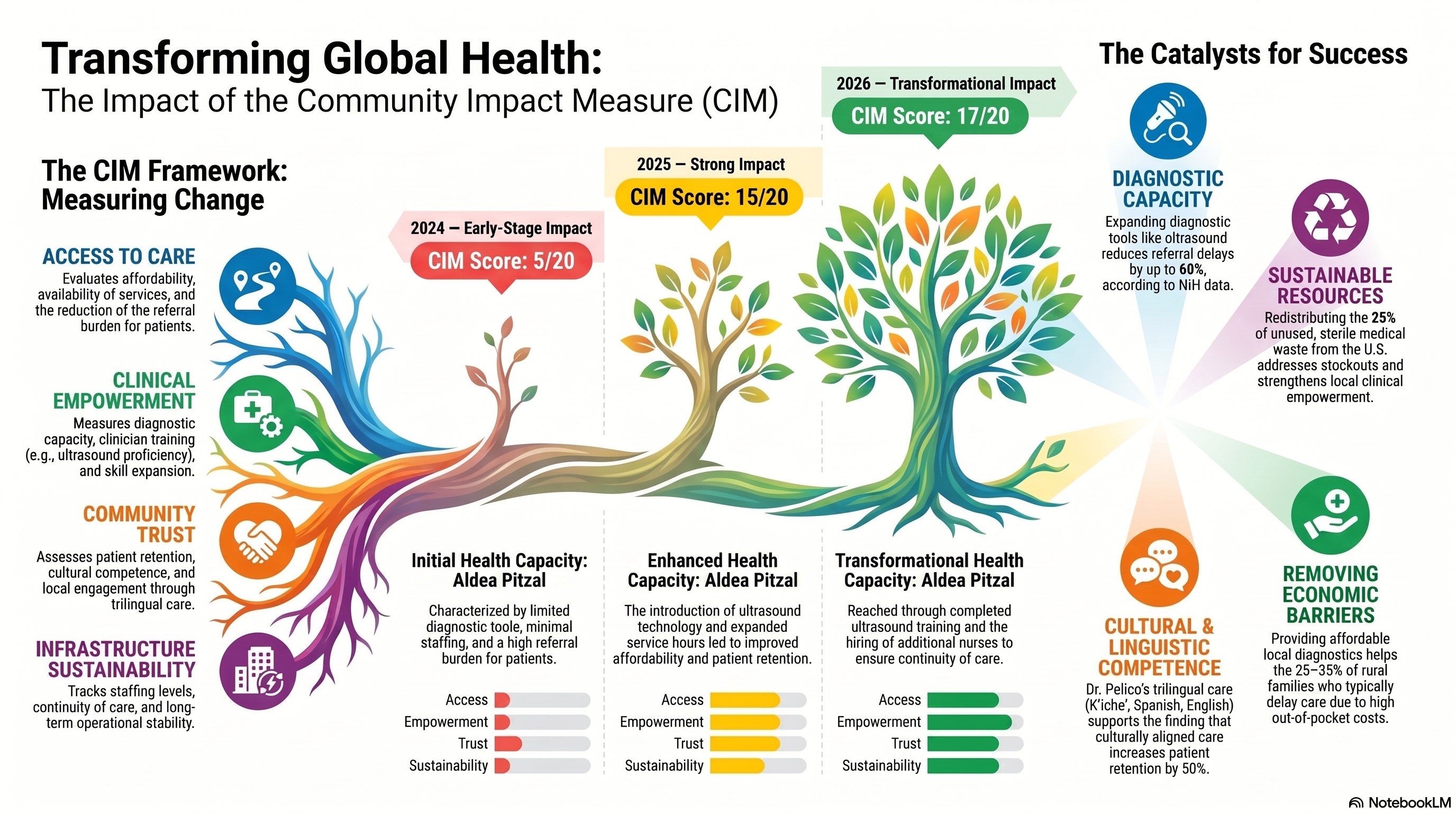
3. Measuring change: the Community Impact Measure (CIM)
PAMA’s Equity in Action program measures impact with the Community Impact Measure, which scores four domains from 0 to 5 each, for a total of 0 to 20:
- Access to Care — clinic visits, reduced travel burden, affordability, night‑time urgent care
- Clinical Empowerment — diagnostic capacity, ultrasound training, EMR‑supported decision‑making
- Community Trust — follow‑up rates, retention, participation, trilingual communication
- Infrastructure Sustainability — staffing, digital systems, continuity‑of‑care protocols, research readiness
| Year | CIM | Stage |
|---|---|---|
| 2024 | 5 | Early stage: limited diagnostics, minimal staffing, high referral burden |
| 2025 | 15 | Strong impact: ultrasound and expanded hours improve affordability and retention |
| 2026 | 17 | Transformational: ultrasound training completed and new nurses hired |
What drove the change, 2024 to 2026:
- +200% diagnostic capacity after ultrasound deployment
- +150% maternal monitoring and early detection
- +300% EMR‑supported continuity of care
- +40% patient retention with trilingual communication
- 60% fewer unnecessary referrals to Guatemala City
- 2026: new nurses, expanded service hours, stronger follow‑up systems
4. What the results show
The combination of technology, language access, affordability and 24‑hour availability has produced a structural change in community health. By 2026 the clinic reached a CIM score of 17, reflecting sustained access, high diagnostic autonomy, strong community trust and durable infrastructure. This trajectory shows that Indigenous‑led, community‑rooted, digitally supported care can rapidly and measurably reduce health disparities in rural Guatemala.
5. Looking ahead
Guatemala’s public health sector doesn’t just need more funding; it needs structural transformation that begins with trust, language access and local leadership. Together with our partners, PAMA envisions a network of Indigenous‑led clinics across Guatemala, each with solar‑powered diagnostic tools, culturally adapted health records and staff fluent in local languages, and a model that can scale to other underserved regions.
These efforts are not charity. They are investments in hemispheric health equity, rooted in the belief that local providers must lead the transformation of their own systems.
Sources
- Pan‑American Medical Association (PAMA). Field reports, diagnostic deployment logs and Community Impact Measure data, 2024–2026.
- PAMA. Equity in Action Program: Diagnostic Expansion in Rural Guatemala. Internal documentation, 2024–2026.
- Borgen Project. Healthcare access in Guatemala: urban–rural disparities.
- UNICEF, WHO and World Bank. Joint Child Malnutrition Estimates, via the Global Nutrition Report, Guatemala Country Nutrition Profile.
- WHO. Global Health Expenditure Database: Guatemala current health expenditure per capita, 2023.
- WHO and UN Inter‑agency Group for Child Mortality Estimation, via Our World in Data, Guatemala health profile.
- PAHO/WHO. Health in the Americas: Guatemala Country Profile.
- UNICEF Guatemala. Indigenous children and barriers to essential services.
- USAID. Guatemala health systems strengthening report.